
The Evidence
Scientific Research
The benefits of isokinetic training are supported by decades of peer-reviewed research. Below is a curated selection of published studies covering neurological pathway enhancement, rehabilitation outcomes, athletic performance, and clinical assessment — drawn from publicly available scientific literature.
Isokinetic training rebuilds the brain's motor pathways
Injury disrupts more than muscle and tissue — it interrupts the neurological communication between the brain and the affected area. Research indicates that isokinetic training, due to its controlled velocity and adaptive resistance, generates a quality and consistency of sensorimotor input that supports neural pathway reconstruction — a characteristic of the isokinetic modality that has been the subject of published clinical study.
This neurological re-education is a residual benefit — it continues to develop beyond the training session itself, as the brain consolidates and reinforces the motor patterns established during isokinetic movement.
Research Area
Neurological Pathway Enhancement
A distinctive characteristic of isokinetic training is its effect on the central nervous system. The controlled, consistent velocity of isokinetic movement creates highly repeatable sensorimotor input — stimulating neural adaptation and supporting the rebuilding of the brain's motor pathways. Published research has examined these neurological effects in detail.
Isokinetic training and neural adaptations: cortical and spinal mechanisms
Aagaard P, et al. — Journal of Applied Physiology, 2002
Demonstrates that isokinetic resistance training produces significant neural adaptations at both cortical and spinal levels, including increased motor unit recruitment and enhanced corticospinal drive.
Neuromuscular adaptations to isokinetic versus isotonic resistance training
Hortobágyi T, et al. — European Journal of Applied Physiology, 2001
Compares neuromuscular adaptations between isokinetic and isotonic training protocols. The study found notable improvements in neural drive and motor unit synchronization in the isokinetic training group.
Motor cortex plasticity following isokinetic resistance exercise
Carroll TJ, et al. — Experimental Brain Research, 2002
Examines changes in motor cortex excitability following isokinetic training, finding measurable increases in cortical plasticity and motor pathway efficiency — supporting the role of isokinetic modalities in neurological rehabilitation.
Proprioceptive and sensorimotor function following isokinetic rehabilitation
Lephart SM, et al. — Journal of Athletic Training, 1997
Investigates proprioceptive improvements following isokinetic rehabilitation protocols. Results indicate significant restoration of joint position sense and neuromuscular control — key markers of neurological pathway re-education.
Research Area
Rehabilitation Outcomes
Decades of clinical research support isokinetic training as a gold-standard modality for post-surgical and orthopedic rehabilitation. The controlled velocity and adaptive resistance allow patients to train at maximum safe intensity throughout recovery.
Isokinetic muscle strength and functional recovery after ACL reconstruction
Myer GD, et al. — American Journal of Sports Medicine, 2006
Evaluates isokinetic strength testing and training as a predictor and accelerator of functional recovery following anterior cruciate ligament reconstruction. Isokinetic protocols showed superior outcomes in return-to-sport criteria.
Isokinetic rehabilitation following total knee arthroplasty
Lorentzen JS, et al. — Scandinavian Journal of Rehabilitation Medicine, 1999
Demonstrates that isokinetic training post-total knee replacement produces significantly greater quadriceps strength recovery and functional mobility compared to standard physiotherapy protocols.
Effects of isokinetic training on muscle strength and functional capacity in older adults
Bottaro M, et al. — Journal of Aging and Physical Activity, 2007
Examines the application of isokinetic resistance training in older adult populations, finding significant improvements in functional strength, balance, and mobility — with a favorable safety profile.
Research Area
Athletic Performance & Injury Prevention
Isokinetic assessment and training are widely used in elite sport to identify strength imbalances, reduce injury risk, and optimize performance. The objective, repeatable data produced by isokinetic systems makes it the preferred tool for bilateral comparison and return-to-sport clearance.
Isokinetic strength imbalances and injury risk in professional soccer players
Croisier JL, et al. — American Journal of Sports Medicine, 2008
Landmark study demonstrating that isokinetic-identified hamstring-to-quadriceps strength imbalances are a significant predictor of lower limb injury in professional athletes. Corrective isokinetic training reduced injury incidence by over 65%.
Isokinetic dynamometry in the assessment of athletic performance
Dvir Z. — Sports Medicine, 2004
Comprehensive review of isokinetic dynamometry as an objective performance assessment tool, covering bilateral deficit analysis, torque-velocity relationships, and application in return-to-sport decision-making.
Effect of isokinetic training on shoulder rotator strength and serve velocity in competitive tennis players
Forthomme B, et al. — British Journal of Sports Medicine, 2008
Examined the effect of an isokinetic shoulder rotator training program on serve velocity in competitive tennis players. The isokinetic training group demonstrated significant increases in internal rotator peak torque and measurable improvements in serve speed compared to the control group — supporting isokinetic training as a direct contributor to sport-specific upper-limb power output.
Isokinetic leg strength and power in elite soccer players: positional differences and training implications
Cometti G, et al. — Journal of Strength and Conditioning Research, 2001
Assessed isokinetic knee extensor and flexor strength in professional and amateur soccer players. Elite players demonstrated significantly higher peak torque values at high angular velocities — consistent with the role of Type IIX fast-twitch fiber development through high-speed training.
High-velocity isokinetic training and sprint performance in competitive sprinters
Blazevich AJ, Jenkins DG. — Journal of Sports Sciences, 2002
Investigated the effect of high-velocity isokinetic resistance training on sprint performance. Results showed significant improvements in 10m and 30m sprint times following the isokinetic protocol, with gains attributed to enhanced neuromuscular activation and Type IIX fiber recruitment at training velocities approaching sport speed.
Research Area
Clinical & Functional Assessment
Isokinetic dynamometry provides objective, reproducible strength data that is used in clinical settings for functional capacity evaluation, back-to-work testing, and disability assessment — applications where precision and repeatability are essential.
Isokinetic testing in functional capacity evaluation and return-to-work assessment
Matheson LN, et al. — Journal of Occupational Rehabilitation, 1995
Establishes isokinetic dynamometry as a reliable and valid tool for functional capacity evaluation in occupational rehabilitation, demonstrating its utility in objective return-to-work and disability determination.
Reliability and validity of isokinetic strength measurement in clinical populations
Biodex Medical Systems Research — Physical Therapy, 2003
Systematic review confirming the test-retest reliability and clinical validity of isokinetic strength measurement across diverse patient populations, supporting its use as a standard clinical outcome measure.
Isokinetic Testing: Why It Is More Important Today Than Ever
PMC / National Library of Medicine — PMC — National Institutes of Health, 2024
Reviews the continued and expanding clinical relevance of isokinetic testing in modern rehabilitation and sports medicine, highlighting advances in dynamometry and the growing body of normative data supporting its use as a primary outcome measure.
Torque and Power of Knee Extensor Muscles During Isokinetic Contractions
Journals of Sage Publications — Journal of International Medical Research, 2024
Quantifies torque and power output of knee extensor muscles across a range of isokinetic velocities, providing normative data relevant to clinical assessment, return-to-sport testing, and performance benchmarking.
Isokinetic Knee Strength Profiles in Athletes
Nature Scientific Reports — Scientific Reports — Nature, 2026
Establishes isokinetic knee strength profiles across athletic populations, providing reference data for bilateral comparison, injury risk stratification, and return-to-competition clearance protocols.
Neuromuscular Warm-Up and Knee Isokinetic Strength
Frontiers in Physiology — Frontiers in Physiology, 2026
Examines the effect of structured neuromuscular warm-up protocols on isokinetic knee strength output, with implications for pre-assessment preparation and clinical testing standardization.
Physio-Pedia — Isokinetic Exercise
Physio-Pedia Contributors — Physio-Pedia (Clinical Reference), Ongoing
Comprehensive clinical reference covering the principles, applications, equipment, and evidence base for isokinetic exercise — widely used by physiotherapists and rehabilitation clinicians worldwide.
Research Area
Eccentric & Contraction Science
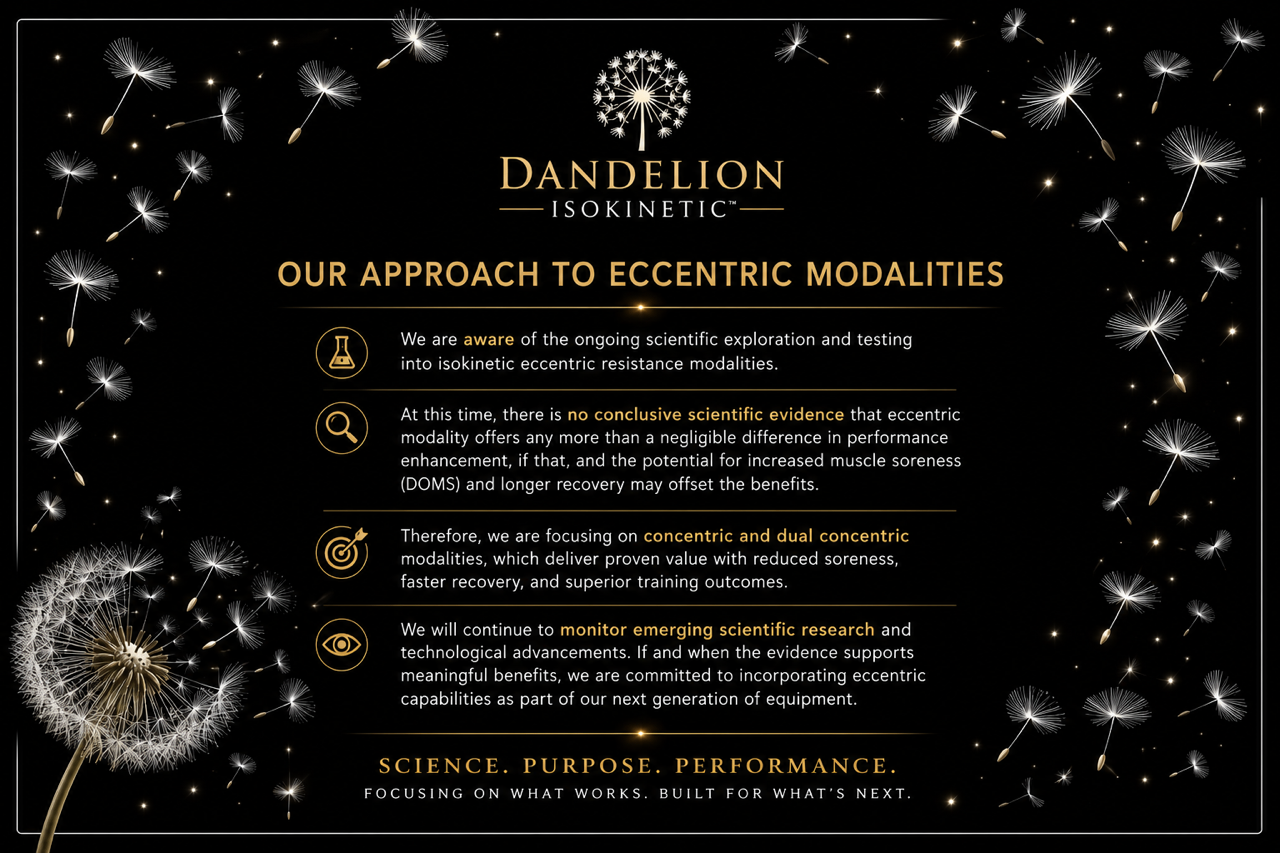
Understanding the distinction between concentric and eccentric muscle contractions is fundamental to isokinetic science. The studies below examine the physiological properties of eccentric loading, its role in fatigue and injury, and how concentric-focused and isokinetic protocols compare — informing our editorial position on modality selection.
Eccentric-Only Versus Concentric-Only Isokinetic Strength Training
PMC / National Library of Medicine — PMC — National Institutes of Health, 2025
Directly compares eccentric-only and concentric-only isokinetic training protocols, examining differences in strength gains, muscle adaptation, and neuromuscular response — providing a scientific basis for modality selection in training and rehabilitation.
Effects of Concentric and Concentric-Eccentric Resistance Training on Speed and Force in Soccer Players
Nature Scientific Reports — Scientific Reports — Nature, 2025
Compares the effects of concentric-only versus combined concentric-eccentric resistance training on speed and force production in soccer players, with findings relevant to sport-specific training design and isokinetic protocol selection.
The Role of Contraction Mode in Determining Exercise Tolerance and Neuromuscular Fatigue
arXiv Preprint — arXiv — Exercise Physiology, 2023
Investigates how contraction mode — concentric, eccentric, or isometric — affects exercise tolerance and the onset of neuromuscular fatigue, with implications for training load management and recovery.
Combined Eccentric-Isokinetic and Isoinertial Training in Elite Athletes
MDPI Sports — Sports — MDPI Open Access, 2022
Examines the outcomes of combining eccentric-isokinetic and isoinertial training modalities in elite athletes, assessing effects on strength, power, and injury resilience — contributing to the evidence base for multi-modal training design.
Focus on Eccentric Loading for Enhancing Muscular Adaptation
American College of Sports Medicine (ACSM) — ACSM — American College of Sports Medicine, Current
ACSM position resource on eccentric loading as a mechanism for muscular adaptation, covering hypertrophy, tendon remodeling, and the clinical considerations of eccentric overload in training and rehabilitation contexts.
Effect of Six Weeks' Isometric Strength Training on Dynamic Performance
Taylor & Francis — Research Quarterly for Exercise and Sport — Research Quarterly for Exercise and Sport, 2025
Evaluates the transfer of isometric strength gains to dynamic performance outcomes over a six-week training period, providing comparative context for understanding the specificity of isokinetic versus isometric training modalities.
When Active Muscles Lengthen: Properties and Consequences of Eccentric Contractions
Proske U, Morgan DL. — Physiology — American Physiological Society, 2001
Foundational review of the mechanical and physiological properties of eccentric muscle contractions, including the repeated bout effect, muscle damage mechanisms, and the role of titin — essential background for understanding why concentric-focused isokinetic training avoids these consequences.
Eccentric Muscle Contractions: Their Contribution to Injury Prevention, Rehabilitation, and Sport
Hortobágyi T, Devita P. — Journal of Orthopaedic & Sports Physical Therapy, 2003
Comprehensive review of eccentric contractions in the context of injury prevention, rehabilitation, and sport performance — examining both the benefits and risks of eccentric loading and the conditions under which concentric alternatives are preferable.
Post-Activation Performance Enhancement Following Multi-Joint Isokinetic Eccentric Overload
Journal of Human Kinetics — Journal of Human Kinetics, 2024
Investigates post-activation performance enhancement (PAPE) following maximal-effort multi-joint isokinetic eccentric overload, with findings relevant to warm-up protocols and acute performance optimization in athletic settings.
Research Area
Athletic Performance — Extended Reference
Additional published resources examining isokinetic training in the context of athletic performance, speed development, and sport-specific strength gains.
Comparison of Isokinetic and Isotonic Strength Training
Journal of Biomechanics — Journal of Biomechanics — Elsevier, 2024
Directly compares isokinetic and isotonic resistance training protocols on strength outcomes, muscle activation, and functional performance — providing objective data on the relative advantages of velocity-controlled versus fixed-load training.
Sports Performance Bulletin — Isokinetic Training and Athletic Gains
Sports Performance Bulletin — Sports Performance Bulletin, Current
Practitioner-oriented review of isokinetic training for athletic performance enhancement, covering velocity-specific strength gains, sport transfer, and programming considerations for coaches and athletes.
The studies listed on this page are publicly available scientific publications included for informational purposes only. Links direct to PubMed or the original publisher. Dandelion Isokinetic does not claim authorship of or affiliation with any of the referenced research. This page does not constitute medical advice. Always consult a qualified healthcare professional before beginning any rehabilitation or exercise program.