
The Science
How Isokinetic Training Works
Isokinetic technology has been used in clinical rehabilitation for decades. We have brought that same precision to a diversified line of equipment — offering solutions across every required sector: home, institutional, commercial, professional, and clinical.
Movement is intuitive. We accommodate the resistance your body wants — at the moment it demands it.
Organic Fitness · High-Speed · Short-Duration Workouts
The Mechanism
Six principles of isokinetic training
Constant Velocity Movement
Isokinetic devices control the speed of your movement. No matter how hard you push or pull, the machine maintains a fixed velocity — ensuring your muscles are engaged at maximum capacity throughout the entire range of motion. Training at the speed of sport means training at up to 1,000°/sec.
Accommodating Resistance
As you move, the device automatically adjusts resistance to match your force output in real time. When your muscles are strong (mid-range), resistance is high. When they are weak (end-range), resistance drops — protecting vulnerable joints while maximizing muscle activation. The same device is used by every user without adjustment: the isokinetic mechanism responds to the individual, not the other way around.
Full Range Engagement at the Speed of Sport
Isokinetic training provides optimal load at every degree of movement at the velocity the user applies. Training at the speed of sport — up to 1,000°/sec — directly activates Type IIX fast-twitch muscle fibers and stimulates neurological pathway reconstruction. The residual benefit continues beyond the session itself: the sensorimotor input of high-speed isokinetic movement rebuilds neural pathways, producing strength and coordination gains that accumulate over time.
Concentric & Dual-Concentric Resistance
Isokinetic resistance is concentric in nature — the movement pattern does not include the eccentric overload phase associated with ballistic training, which published research identifies as a contributing factor in delayed-onset muscle soreness and joint stress. Dual-concentric configurations allow both the agonist and antagonist muscle groups to work concentrically in a single movement, doubling the training stimulus.
Type IIX Fast-Twitch Fiber Activation
High-velocity isokinetic training specifically recruits Type IIX white fast-twitch muscle fibers — the fibers responsible for explosive power, speed, and athletic performance. These fibers are activated at high movement speeds, and isokinetic training at sport-speed (1,000°/sec) is designed to reach those velocities.
Neurological Pathway Reconstruction
Injury disrupts the communication between your brain and muscles. The controlled, repeatable sensorimotor input of isokinetic training rebuilds these neural pathways — a residual benefit that continues developing beyond the training session itself, as the brain consolidates the motor patterns established during isokinetic movement.
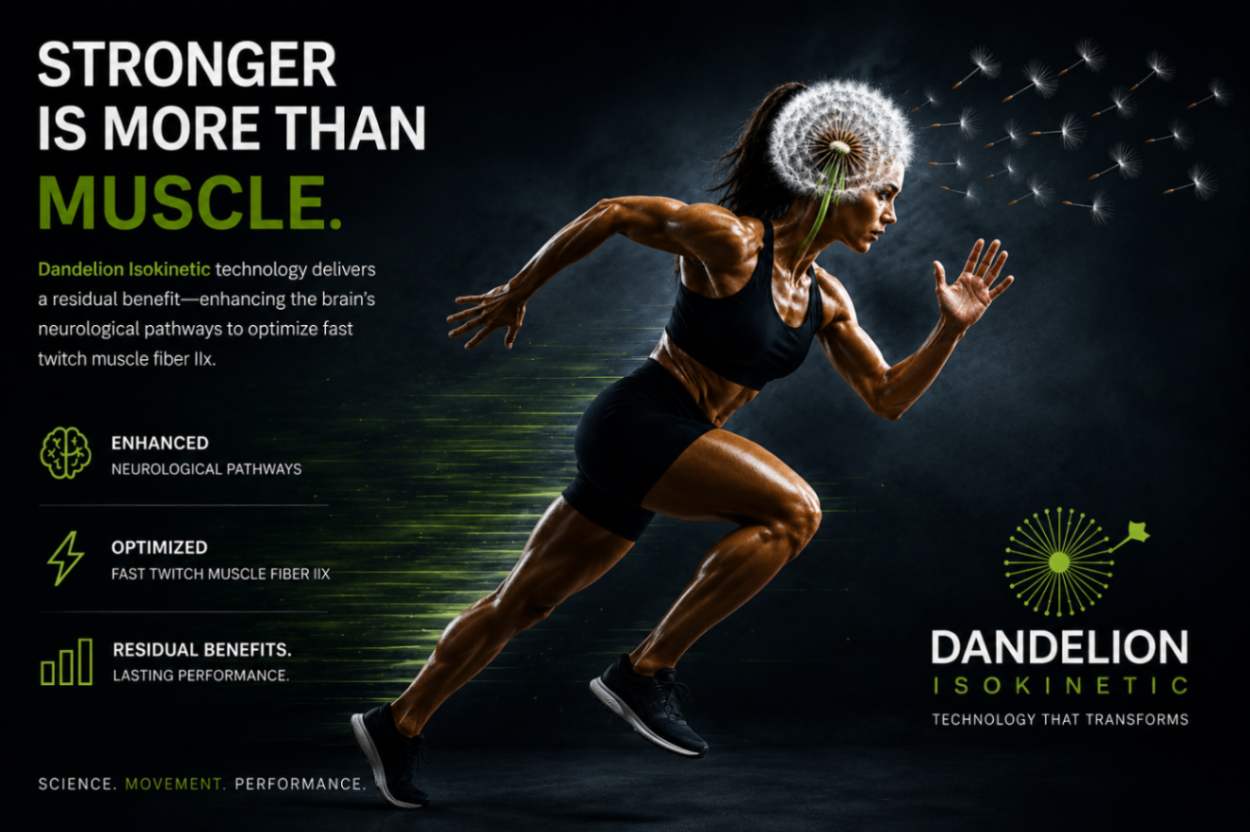
Type IIX Fast-Twitch Muscle Fiber
Type IIX white fast-twitch muscle fibers are the engine of explosive athletic performance. They are only recruited at high movement velocities — which is why conventional slow-speed resistance training fails to develop them proportionally.
Isokinetic training at the speed of sport — up to 1,000°/sec — directly targets these fibers, producing strength, power, and neuromuscular adaptations that translate directly to athletic performance and functional recovery. This is what it means to train fast to be fast.
The Isokinetic Modality
Characteristics of isokinetic training
Every training modality has its own properties and appropriate applications. The following table reflects the documented mechanical and physiological characteristics of each modality as described in published exercise science literature.
| Characteristic | Free Weights | Resistance Bands | Isokinetic |
|---|---|---|---|
| Accommodating resistance throughout range of motion | ✗ | ✗ | ✓ |
| Constant velocity control | ✗ | ✗ | ✓ |
| Concentric-only loading (no eccentric overload) | ✗ | Partial | ✓ |
| Dual-concentric resistance option | ✗ | ✗ | ✓ |
| Type IIX fast-twitch fiber activation at sport speed | Partial | ✗ | ✓ |
| Training velocity up to 1,000°/sec | ✗ | ✗ | ✓ |
| Neurological pathway re-education | Partial | ✗ | ✓ |
| Self-limiting — resistance cannot exceed user output | ✗ | ✗ | ✓ |
Characteristics based on published exercise science literature. Free weights and resistance bands are established and widely used training modalities — this table reflects mechanical properties specific to each, not a ranking of overall training value.
Common Questions
Frequently asked questions
Is isokinetic training safe for independent use?
Yes. Isokinetic technology is inherently self-limiting — the device can only provide resistance up to the force you apply. This means the load cannot exceed your current capacity at any point in the movement. All resistance is concentric, and the eccentric overload phase associated with ballistic training — which research identifies as a contributing factor in muscle soreness and joint stress — is not present in isokinetic movement. This makes it appropriate across all sectors: home, institutional, commercial, professional, and clinical.
What makes isokinetic training different from other forms of resistance training?
Isokinetic training is a distinct modality with specific characteristics: speed-controlled movement, accommodating resistance that adjusts to your force output throughout the range of motion, and concentric-only loading. Each form of resistance training has its own properties and applications. Isokinetic training is designed around the principle that the resistance delivered should always equal exactly the resistance the user applies — no more, no less.
What is "speed of sport" training?
Sport movements occur at speeds of up to 1,000 degrees per second. High-speed isokinetic training is designed to allow users across all sectors — home, institutional, commercial, professional, and clinical — to train at or near those velocities, specifically activating Type IIX fast-twitch muscle fibers and rebuilding the neurological pathways required for explosive, functional movement.
Do I need a physical therapist to use this equipment?
No. Dandelion Isokinetic equipment is intuitive and safe for users of all ages and across all environments — no clinical supervision is required for independent use. The isokinetic mechanism is inherently self-limiting: it can only provide the resistance you apply, making it impossible to overload a joint or muscle beyond its current capacity. Please consult your physician before commencing any exercise program.